Sicily
Sicily is less an Italian island than a Mediterranean crossroads that happens to be Italian. Greek temples, Arab-Norman cathedrals, Baroque hill towns, an active volcano and arguably the best street food in Europe, all on one drive.
March–October lands in summer for Sicily: warm, sunny weather ideal for the coast; prime hiking and outdoor season with the trails and passes open; calm seas and swimmable water.
How to split the island
Sicily is big: roughly 250 km across, so pick two bases rather than trying to circle it in a week. The east (Catania, Taormina, Syracuse, Etna, the Baroque Val di Noto) is the stronger half for first-timers. The west (Palermo, Cefalù, Trapani, Erice, Agrigento) is grittier, better for food and less polished.
A two-week loop covers both comfortably: fly into Catania, work south through Syracuse and Noto, cross to Agrigento, north to Trapani and the Egadi islands, then Palermo and Cefalù before returning. A rental car is essential - trains are slow and coastal roads are the point.
Etna and the volcanic landscape
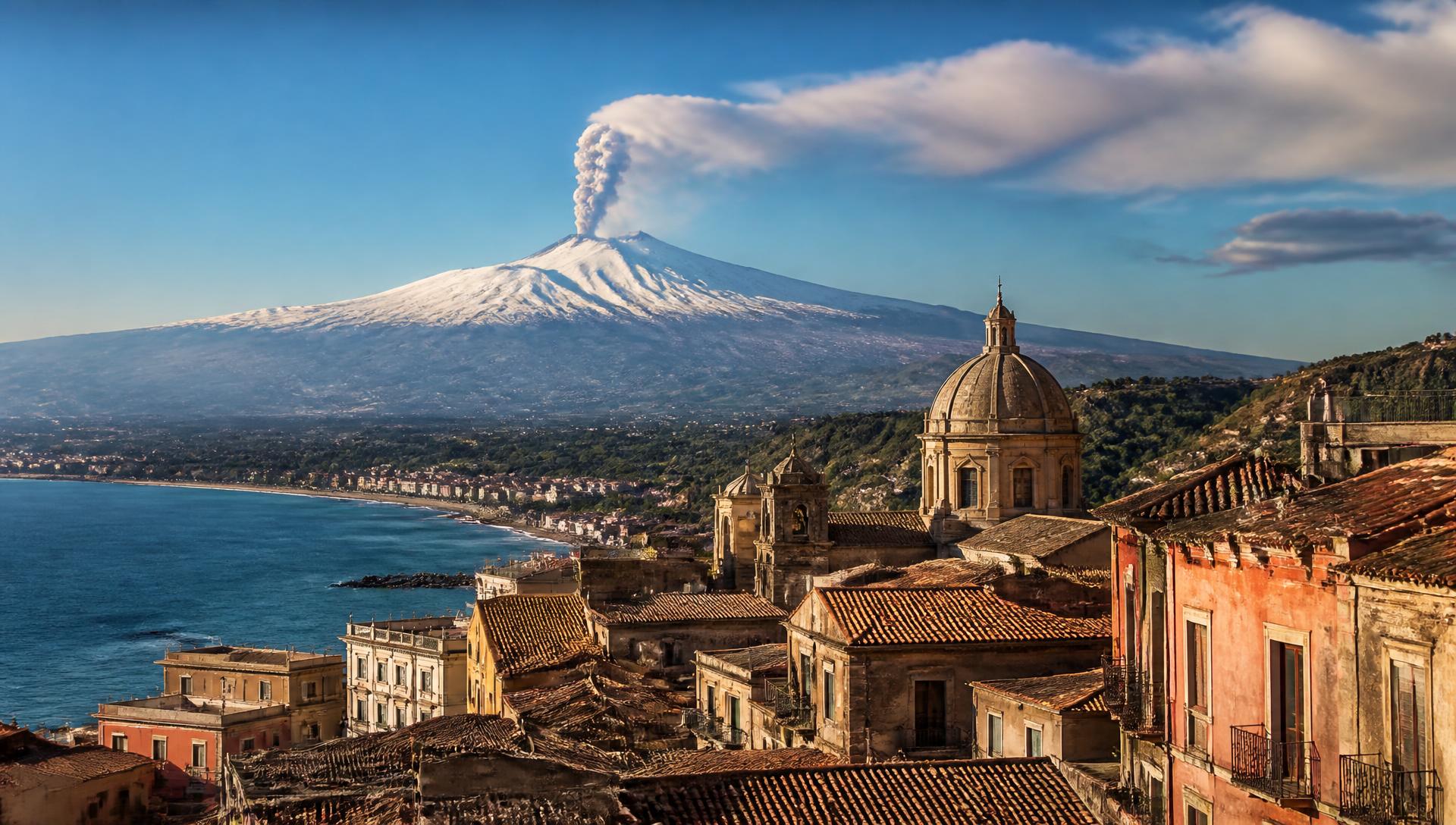
Mount Etna (about 3,300 m and constantly changing) is Europe's most active volcano and the island's defining presence. From the Rifugio Sapienza side you can take the cable car and 4×4 to around 2,900 m; to go higher toward the summit craters you need an authorised alpine guide, and access depends entirely on current activity. The lower slopes are just as good: lava caves, old flows and a hiking trail network through chestnut forest.
Etna's soil also makes the island's most interesting wine. Etna Rosso from Nerello Mascalese grows on terraced slopes around Randazzo and Linguaglossa; several estates do tastings with the volcano as the backdrop.
Offshore, the Aeolian Islands extend the theme. Stromboli's nightly eruptions and Vulcano's steaming fumaroles are a two- to three-day add-on by ferry from Milazzo.
Ruins, Baroque and cities
The Valley of the Temples at Agrigento holds the best-preserved Greek temples anywhere outside Greece: go at opening or for the evening illumination to dodge the heat. Segesta and Selinunte in the west are quieter and, in Segesta's case, spectacularly sited alone on a hillside.
Syracuse pairs a Greek theatre and the vast Neapolis park with Ortigia, an island old town of honeyed stone that is the single most pleasant place to stay on the island. Inland, the Val di Noto, Noto, Modica, Ragusa Ibla, Scicli, was rebuilt in unified late Baroque after the 1693 earthquake and is UNESCO-listed as a set.
Palermo is the wild card: chaotic, layered, and home to the Arab-Norman Cappella Palatina and the mosaics of Monreale just outside town.
Beaches and the sea
The southeast around Vendicari and San Lorenzo has long sandy beaches and a nature reserve with flamingos. San Vito Lo Capo in the northwest is the classic wide-sand-and-turquoise choice, next to the Zingaro Reserve's string of walk-in coves.
For clearer water still, ferry out to the Egadi Islands (Favignana, Levanzo) from Trapani, or Lampedusa far to the south. Sea temperatures stay swimmable from June into October.
Eating in Sicily
Sicilian food is the reason many people return. Street food first: arancini, panelle, sfincione and, for the brave - pani ca meusa in Palermo's Ballarò and Vucciria markets. Then pasta alla Norma (aubergine, ricotta salata), pasta con le sarde, and couscous with fish in the Arab-influenced west around Trapani.
Sweets are a separate category: cannoli filled to order, cassata, Modica's grainy Aztec-style chocolate, and granita with brioche for breakfast, almond or pistachio in the east, lemon in summer.
When to go & what it costs
May, June, September and October are ideal: hot enough to swim, mild enough to walk ruins at midday. July and August are fierce (40°C inland is normal) and busy with Italian holidaymakers. Spring brings wildflowers over the temple sites; winter is quiet and green but many coastal places close.
Sicily is noticeably cheaper than northern Italy. Two people can travel well on roughly €120-200 per day including a rental car, mid-range agriturismo or B&B, and eating out twice daily.
Want to find more places like Sicily?
Answer a few questions and get matched to 170+ destinations worldwide.
Find my matches