Easter Island (Chile)
Rapa Nui is the most remote inhabited island on Earth: 3,500 km from the nearest continent, and the strangeness of that isolation is the whole experience. Nearly a thousand carved stone ancestors stand on a grassy volcanic triangle you can drive across in an hour.
April–May and October–November are the two windows that work best for Easter Island (Chile): warm, sunny weather ideal for the coast; prime hiking and outdoor season with the trails and passes open; calm seas and swimmable water. The months in between are skipped; they're the peak-season extremes for Easter Island (Chile).
Understanding the moai
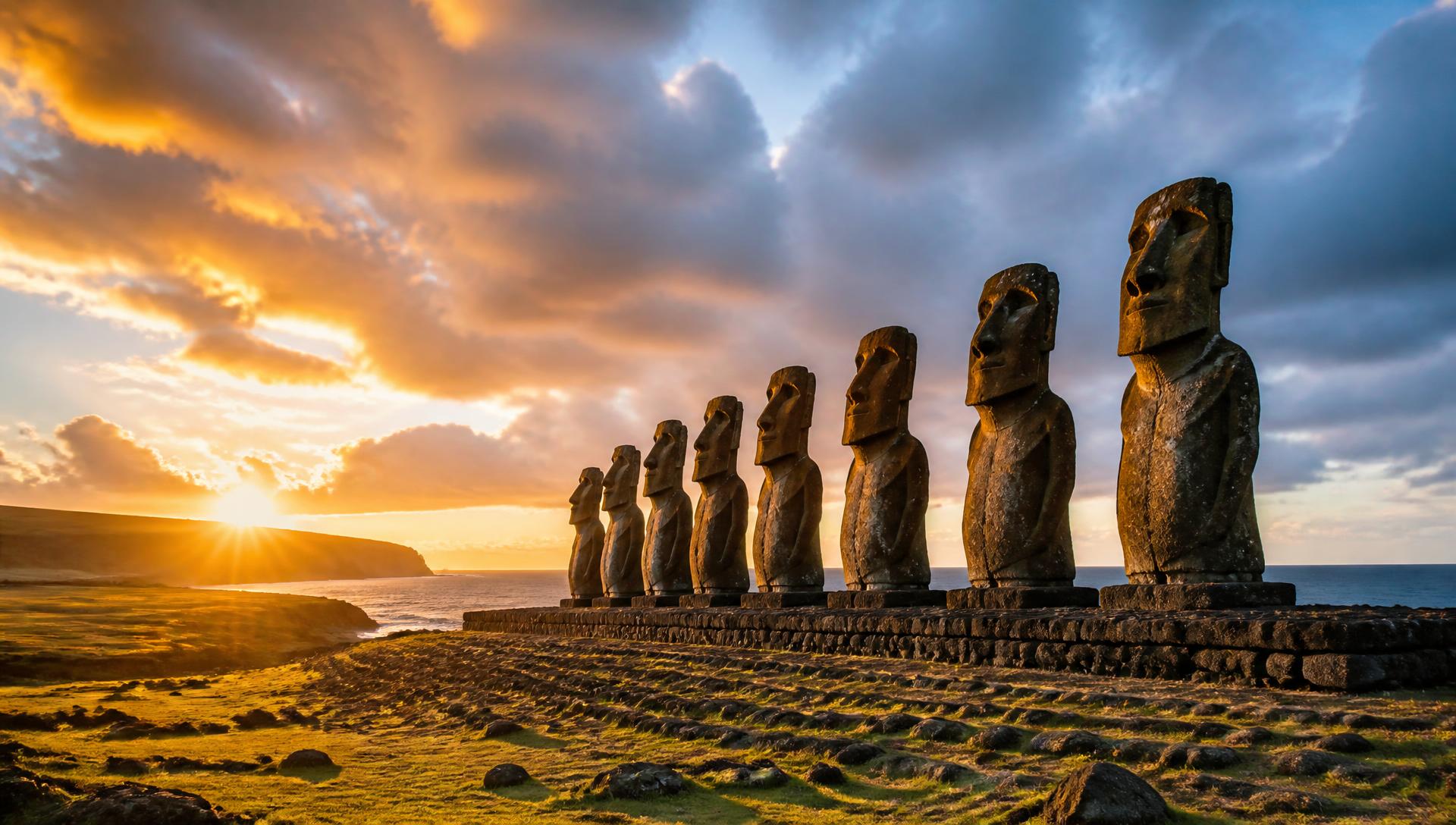
The moai are ancestor figures, carved between roughly 1250 and 1500 CE and raised on stone platforms called ahu, almost always facing inland to watch over the settlement rather than out to sea. Nearly all were quarried at one site, Rano Raraku, and somehow moved kilometres across the island.
Rano Raraku is the unmissable stop: an entire hillside of unfinished statues frozen mid-production, including one still lying in the rock 21 metres long. Nearby Ahu Tongariki has fifteen restored moai in a line against the ocean and is the classic sunrise spot. Ahu Akivi is the rare inland set that does face the sea, and Ahu Tahai, walkable from town, is the best sunset.
The later birdman cult at Orongo, perched on the rim of the Rano Kau crater above sheer cliffs, tells the second half of the island's story and is worth a slow visit.
Beyond the statues
The island is volcanic and walkable. Hike or bike to the Rano Kau crater lake, climb Maunga Terevaka (the high point, with 360° ocean views), and explore the lava tube caves at Ana Kakenga and Ana Te Pahu.
Anakena is the island's one proper beach: white coral sand, palms and its own row of moai, and the water is warm enough to swim year-round. Diving and snorkelling around the offshore islets is exceptional for visibility, if light on fish.
Rapa Nui culture is very much alive: catch a traditional dance performance in Hanga Roa, and if your dates allow, the Tapati Rapa Nui festival in early February is two weeks of competitions, body paint and canoe races.
Permits, guides and rules
Almost everything sits inside Rapa Nui National Park, which requires a park ticket bought on arrival or online; it is valid for a set number of days and is checked at every site. Rano Raraku and Orongo can only be entered once per ticket, so plan those visits properly rather than dropping in.
Most sites now require a local guide, and independent wandering off marked paths is prohibited. This is not bureaucracy for its own sake, the sites are fragile and sacred. Never touch, climb on or walk onto an ahu. Fines are real and enforced.
Getting there & practicalities
LATAM flies from Santiago (about 5.5 hours) and it is essentially the only route, a handful of flights per week, occasionally continuing to Tahiti. Book early; fares swing wildly and the plane is often full. Chile requires arriving visitors to have accommodation booked and a return ticket.
Everything is based in Hanga Roa, the single town. Rent a car, quad or bike for a day or two: there is no public transport and taxis add up. Bring cash: card acceptance is patchy and there are few ATMs. Almost all food and fuel is shipped in, so prices are high - expect Santiago prices roughly doubled.
Three to four full days is the right length: enough for the main circuit, a sunrise at Tongariki, a hike and a beach afternoon without rushing.
When to go
The island is subtropical and mild all year, but windy and prone to sudden rain. April–May and October–November are the sweet spots: warm, drier, and outside both the southern-summer crowds and the winter squalls.
January–February is warmest and busiest, and includes Tapati; June–August is cooler, wetter and much quieter, with the lowest prices.
Want to find more places like Easter Island (Chile)?
Answer a few questions and get matched to 170+ destinations worldwide.
Find my matches