Namibia
Namibia is the great self-drive country: gravel roads that run for hours without a car, the oldest desert on earth, wildlife around waterholes and skies so dark the Milky Way casts a shadow. It's Africa for people who like their space.
May–October lands in the southern winter for Namibia: warm, sunny weather ideal for the coast; prime hiking and outdoor season with the trails and passes open; calm seas and swimmable water.
The desert south
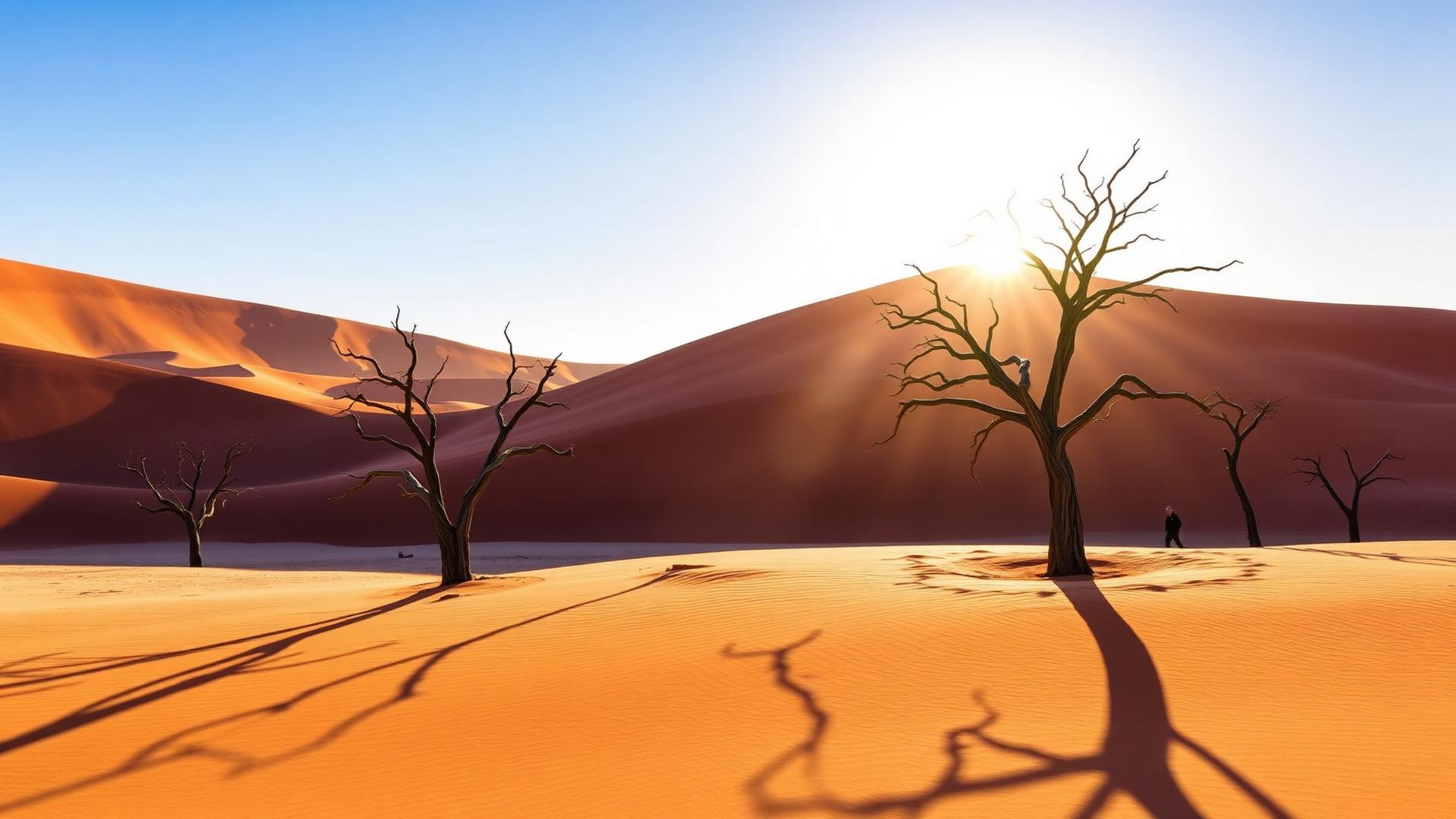
Sossusvlei in the Namib-Naukluft is the headline: apricot-coloured dunes up to 300 m high, the salt pan of Deadvlei with its 900-year-old blackened camelthorn trees, and Dune 45 for the sunrise climb. Stay inside the park gate at Sesriem to enter an hour before everyone else, the light is everything here.
South of that, the Fish River Canyon is the second-largest canyon in the world, and Lüderitz with the sand-filled ghost town of Kolmanskop makes a strange, worthwhile detour. Distances are long; plan two nights minimum per stop.
Wildlife at Etosha
Etosha National Park is built around a vast salt pan, and its genius is the waterholes: in the dry season you park at one and let elephant, giraffe, zebra, oryx, black rhino and lion come to you. The floodlit waterholes at Okaukuejo and Halali offer some of the best night viewing in Africa.
Etosha is fully self-drive-able on good gravel roads with ordinary vehicles, which makes it far cheaper than the fly-in camps of Botswana. Three nights lets you cover the eastern and central sections properly.
Damaraland, the coast and the Caprivi
Damaraland is the most atmospheric part of the country: desert-adapted elephant and rhino, the ancient rock engravings at Twyfelfontein, and granite landscapes around Spitzkoppe that glow at sunset.
Swakopmund is a startling slice of German colonial architecture on the Atlantic, and the base for dune quad-biking, sandboarding and the seal colony at Cape Cross. North of it, the Skeleton Coast delivers fog, shipwrecks and genuine emptiness. Far to the northeast, the Zambezi (Caprivi) Strip is green, riverine and a natural bridge to Botswana and Victoria Falls.
Self-driving Namibia
Fly into Windhoek (WDH). Rent a 4×4 with two spare tyres; most main routes are gravel rather than tar, and punctures are the standard hazard. Keep speeds around 80 km/h on gravel, never drive after dark (animals on the road), and carry extra water and fuel: stations can be 200 km apart.
A rooftop-tent vehicle with camping gear is the classic and most affordable way to travel; lodges are also excellent and often superbly sited. Download offline maps: mobile coverage disappears for long stretches. A typical two-week loop is Windhoek → Sossusvlei → Swakopmund → Damaraland → Etosha → Windhoek.
When to go & what it costs
May to October is the dry winter: cool mornings, warm days, no rain and the best wildlife concentration around waterholes. September and October are hottest and best for game but busy. The green season (January-April) is beautiful and quiet, with dramatic skies and occasional flooded roads.
Namibia is mid-range value: roughly $180-300/day for two people with a 4×4 rental, mixed camping and lodges, park fees and fuel. Fuel and distance are the biggest hidden costs: budget for 3,000-4,000 km on a two-week loop.
Eating: braai it yourself or feast at the lodge
Namibia is a braai country, and self-catering is half the fun of the drive. Every campsite has a fire pit or braai grid, and supermarkets in Windhoek, Swakopmund and Otjiwarongo stock excellent boerewors, lamb chops, kudu or oryx steaks, potjie ingredients and firewood. Stock a cooler box at the start of each leg, buy meat and charcoal in the last real town before the park, and cook under the stars, with dark-sky views like these, dinner takes hours.
When you don't feel like cooking, lodges do the other extreme superbly: game meat done properly. Expect oryx (gemsbok) fillet, kudu loin, springbok shank, zebra carpaccio and Kalahari lamb, often with a German-colonial streak: apple strudel, dark bread, cold Windhoek Lager or Tafel. On the coast, Swakopmund and Walvis Bay swap the desert menu for oysters, fresh kabeljou and hake, and the odd plate of Bavarian sausage.
Want to find more places like Namibia?
Answer a few questions and get matched to 170+ destinations worldwide.
Find my matches